
MPhil Programme
MPhil study at the MRC Toxicology Unit
The MPhil programme at the MRC Toxicology Unit aims to deliver advanced level training in mechanistic toxicology research and offers students the opportunity to undertake a period of supervised research followed by submission of a thesis, taught modules are not a component of the course. The MRC Toxicology Unit provides a supportive learning environment designed to meet the scientific and transferable skills required for an internationally competitive career.
Students are registered for their MPhil with the Postgraduate School of Life Sciences at the University of Cambridge and have membership of a University of Cambridge College.
The training needs specific to a particular research project will be identified and training will be provided in these areas, along with skills training in topics such as research ethics, statistics and bioinformatics. Students may also attend the week-long training event in toxicology provided by the Integrative Toxicology Training Partnership (ITTP) and the Toxicology Unit’s research seminars. In addition, students will be encouraged to attend topic-relevant seminars within the University.
MPhil Studentship Awards
Four MPhil studentship awards covering fees and maintenance for home students are available, these are funded by the Large Grant Contributions Fund at the University of Cambridge to support the Prosperity Partnership award from the Medical Research Council.
These MPhil studentships will undertake research projects that align with understanding the toxicities associated with nucleic acid-dependent therapies (NADTs) such as ASOs, siRNAs, and CRISPR-Cas9. These research projects will focus on mechanistic understanding of these toxicities, development of human-relevant testing systems and predictive modelling.
Students interested in these studentships should have a broad interest in undertaking a career in toxicology and be able to demonstrate a strong record of academic performance.
These studentship awards are designated to support applicants from underrepresented backgrounds to access postgraduate study at Cambridge. They are reserved for applicants who identify as/ identify as belonging to one of the following groups:
- Identifying as belonging to an underrepresented ethnic group.
- Granted refugee status in the UK.
- Mature students.
- Have received free school meals.
- At the time of applying for their undergraduate course, were living in one of the most deprived areas of the country.
- At the time of applying for their undergraduate course, were living in an area where it is unusual for young people to go to university.
- Were the first generation of their family to go to university.
- Entered university at undergraduate level from a Care background or a Foyer resident.
- Estranged from their family.
- Have caring responsibilities for an ill or disabled family member who could not manage without this help.
- Have been a single parent, or lone guardian of a young person who is aged under 18 and/or still in full-time education during their undergraduate degree course.
- Received full state support for maintenance for their course of undergraduate study.
Eligibility
To qualify for consideration for one of these MPhil studentship awards, you must:
- Be a Home (UK fee rate) student.
- Be predicted to achieve, or have already achieved, a 1st or high 2i in your undergraduate degree.
- Be from one of the underrepresented backgrounds listed above.
- Not already qualified at Master's level or higher.
How to apply if you meet the above eligibility criteria
- Candidates that meet the above eligibility criteria should make a formal application through the Applicant Portal. The course is listed in the Application Portal as "Biological Science (MRC Toxicology Unit) MPhil". It is recommended that you take time to check the application requirements including the documentation you will need to upload.
- Candidates should complete the studentship award form. Please note applicants that have not completed the studentship award form will not be considered.
- The department will review your application, and you will be invited to attend interview if shortlisted.
- If your application is successful, a conditional offer is communicated by email and the self-service account.
- The closing date for applications is the 2nd April 2026.
- You may be eligible for an application fee waiver
How to apply if you do not meet the above eligibility criteria
If you do not meet the above eligibility criteria and are still interested in pursuing an MPhil in these topics, you will need to have your own means of paying fees and living costs (self-funded studentships) and / or seek separate funding from student finance, charities or trusts. There are many funding opportunities at Cambridge from a wide variety of sources including the Cambridge Trust, Gates Cambridge, Colleges, Departments, Research Councils and central University funds. Note that there are differing deadlines for postgraduate funding applications.
- Candidates that are self-funded should make a formal application through the Applicant Portal. The course is listed in the Application Portal as "Biological Science (MRC Toxicology Unit) MPhil". It is recommended that you take time to check the application requirements including the documentation you will need to upload.
- Candidates should complete the studentship award form and check the self-funded box. Please note applicants that have not completed the studentship award form will not be considered.
- The department will review your application, and you will be invited to attend interview if shortlisted.
- If your application is successful, a conditional offer is communicated by email and the self-service account. The offer can only be accepted once funding and other conditions are met.
Student Testimonials
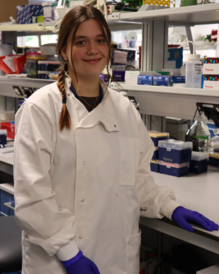
Amy Lewis - "The MPhil programme here at the MRC Toxicology Unit is great because you get to do a year of full-time research. You are a fully integrated member of the unit, like any PhD student or member of staff, something that I think is rare for a master’s programme.
Completing a year of full-time research, followed by a written thesis, is a great ‘PhD taster’! It can help you decide if that’s the right next step for you and will also help strengthen your application. The unit has excellent specialist facilities, so the variety of things you can learn is massive."(Full Testimonial)
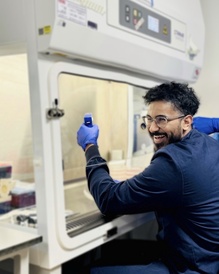
Anfas Muhammed - "I did my undergraduate degree at the University of Delhi. Delhi, as many might know, is an extremely polluted city, and I had completed a project on the impact of pollution on asthma. That exploration deepened my interest in how cells respond to chemical stressors, eventually leading me to join the MRC Toxicology Unit for an MPhil.
I remember walking into the Unit for my interview with my PI and thinking it was one of the most well-maintained, organised, and well-equipped labs I had ever been to. There was plenty of personal space for students and employees, both in the lab and in the office area. It was such a peaceful environment that I even spent a major part of my writing period at the Unit." (Full Testimonial)