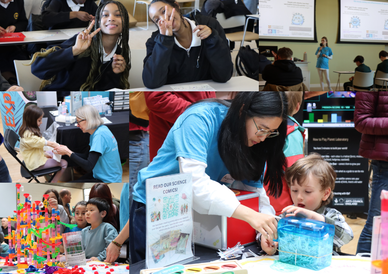

Researchers from the MRC Toxicology Unit returned to the Cambridge Festival 2026 last week to engage school students and families with our research.
The Cambridge Festival is an annual event coordinated by the University of Cambridge’s Public Engagement team. It is a multi-disciplinary festival with a mixture of online, on-demand and in-person events covering all aspects of the world-leading research happening in Cambridge.
25 researchers & Unit staff took part in the Schools Day on 26th March and the Families Weekend on 28th and 29th March sharing more about the science that we do. Our CamFest this year kicked off with a new workshop for 11-14 year olds called 'How Antibodies Save Lives' and introduced KS3 students to our immune system, immunologists & how we are using antibody science to make medicines safer and more effective. As part of this workshop, we led a craft activity to make a beaded antibody keyring in a Y-shape to remind them of the constant and variable regions that make up an antibody. For the Families Weekend, we brought back our ever popular temporary tattoo parlour complete with 7 new designs. We also had our giant tactile cell with a few mini activities to introduce visitors to the different components of our cells (called organelles), what their jobs are and how things in our environment including medicines can affect them. It was thoroughly enjoyed by all - particularly our endoplasmic reticulum marble run!
Our final activity was on-demand and is a series of videos that our staff and students have made showing what a typical day in their lives may look like. These are not just for the Festival so you can access them on our YouTube channel anytime.
It was fantastic to be able to meet so many visitors over the three days, share our research and do fun activities with over 1000 of you!
Thank you to all our volunteers who made our research come to life on the day and in the planning: Simone Baldan, Madeleine Thiemann, Sophie Heese, Emma Gould, Kirsti Hornigold, Amrita Mukherjee, Gavin Garland, Daniel Elrich, Rebecca Raven, Lizzie Glading, Odara Medagedara, Sophie Breusegeum, Anjelika Galapon, Aditi Madkaikar, Tyler Myers, Stephen Kamrad, Mengjia Li, Joanna Salmon, Mark Southwood, Lucy Womack, Nina van der Velde, Evie Mackenzie, Vitalina Chamberlain-Evans, Anfas Muhammed, Melika Fard & Tiago Marques Pedro. An additional thank you to Purnima Kumar and Nida Ali from the Gurdon Institute and the Department of Biochemistry who supported our activities by volunteering their time.