

Rob Bradley, a research associate in the Patil group, recently took part in the Dementia and Parkinson’s Disease Open Day, a meeting held at Addenbrooke’s Hospital with patients and their relatives. Rob shares what the meeting was about and how he found the experience:
Attending the PD Open Day
by Rob Bradley
For the past 6 months, I have collaborated with Marta Camacho, a research associate within the Department of Clinical Neurosciences investigating the role of the gut-brain axis in Dementia and Parkinson’s disease (PD). Together, we’re investigating whether people living with Parkinson’s have been exposed to more environmental contaminants than those who don't have the condition, by measuring the concentration of contaminants in their blood. In our pilot screen, we didn’t find significantly higher concentrations of our target compounds in the blood of people living with Parkinson’s. However, the initial study was small, and we would need to expand our sample size before coming to any conclusions.
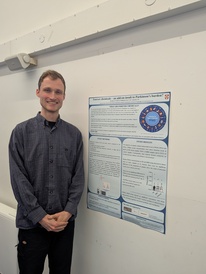
Marta organises an annual outreach event called the PD Open Day, providing an opportunity for researchers to communicate their work with people with Parkinson’s and their family members to learn about and have input into the latest research and clinical trials. Marta invited me to present a poster detailing the results from our collaboration and I was more than happy to accept.
The day kicked off with research talks, with several lab members and guests promoting cutting-edge research and planned clinical trials to the attendees. Engagement with the talks was really high, with lots of audience members getting involved in the discussion. Speaking to a few people in the break, they were pleased the talks didn’t shy away from the more technical details. There was probably some selection bias (many of the attendees were ex-doctors and researchers) but I spoke to people who had no research experience who were just as interested in the hardcore science. This was very eye-opening and made me reflect on how important it is to know your audience when presenting.
After the research talks, we heard from a person with Parkinson’s who had been diagnosed at a young age and had 8 years ago become the first participant in an experimental gene therapy trial. Hearing his positive outlook on life and how research had helped him personally was really powerful.
We also heard from the Cambridge Brain Bank who were encouraging people to sign up to donate their brains for research. I am now registered (hopefully I won’t be donating any time soon) and if you’re interested you can email here: Donating your body to medical science | CUH.
Whilst presenting my poster I had great conversations with the attendees. I heard lots of stories about exposure to now-banned environmental contaminants including asbestos, lead and pesticides. Reflecting on these stories, I was encouraged that at least some of these historical contaminants are now regulated but disheartened that we are facing the same issues with new pollutants. Despite this, I left the session feeling proud to be involved in research helping to tackle the issue of environmental toxins. Seeing how engaged the participants were really highlighted the benefits of outreach and it was clear that both the attendees and the researchers took a lot from the day. I left feeling freshly motivated to carry on with this work and will definitely aim to get involved in outreach again!