
We asked Sawarkar Lab student Anfas about his research at the Tox Unit, why he chose to study an MPhil and what he likes to do when he's not in the lab.
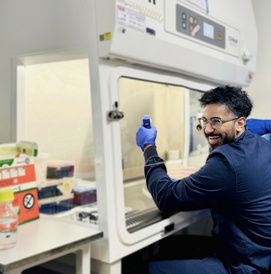
What is your research about?
When cells in our body encounter extreme heat, the bonds within proteins break, causing them to misfold. Misfolded proteins cannot function properly; they begin to aggregate and interfere with normal cellular processes. To manage this, cells produce helper proteins known as heat shock proteins (HSPs), which assist in refolding improperly folded proteins. Depending on their molecular weight, HSPs are classified into different families.
My research focused on the heat shock protein HSP90, named for its molecular weight of 90 kilodaltons. What makes HSP90 special is that, unlike other HSPs, it contains intervening sequences called introns within its gene. These introns pose a challenge because they must be removed through a process called splicing before the protein can be synthesised. During heat stress, cells enter a state of emergency, and splicing takes additional time, slowing protein synthesis. It remains puzzling why HSP90 retains introns despite this disadvantage and how these introns are removed to generate functional proteins.
My project identified and characterised a novel gene potentially involved in the splicing of stress-induced proteins such as HSP90, and found the first evidence to suggest that splicing may function as a regulatory checkpoint during cellular stress, helping the cell decide between survival and death.
In the future, this line of research could be useful for further understanding diseases associated with protein-misfolding such as Alzheimer’s and Huntington’s.
What do you enjoy about working in the MRC Toxicology Unit?
I like that there’s always something happening at the Unit. If you find some free time between experiments — you are assured to never be bored. There is probably a talk you can go to, or group activities you could do, like crafts or yoga, or events you can volunteer for.
I also enjoy coming to the break room to grab a healthy fruit or a not-so-healthy pastry and a cup of hot chocolate after a few hours in the lab to chat with my lab members. But my favourite part of all is the stationery cupboard. It has everything you’d need for a stationery junkie like me: lots of coloured Sharpies, varieties of pens, sticky notes, organising folders, and such.
What made you want to do an MPhil? What attracted you to the MRC Toxicology Unit/your field of research?
I did my undergraduate degree at the University of Delhi. Delhi, as many might know, is an extremely polluted city, and I had completed a project on the impact of pollution on asthma. That exploration deepened my interest in how cells respond to chemical stressors, eventually leading me to join the MRC Toxicology Unit for an MPhil.
I remember walking into the Unit for my interview with my PI and thinking it was one of the most well-maintained, organised, and well-equipped labs I had ever been to. There was plenty of personal space for students and employees, both in the lab and in the office area. It was such a peaceful environment that I even spent a major part of my writing period at the Unit.
What do you like to do outside of work?
After a long day in the lab, I like to play ping pong and tennis at my college. On weekends, I also go for cycle rides with my friends — Cambridge is such a scenic city that you never run out of things to see. I also enjoy teaching kids in my spare time. Recently, I volunteered at a summer programme across a few Cambridge colleges to mentor high school students from Iceland and Japan.
What are you planning to do next?
Step 1 is to go back home, take a well-deserved break, and travel a little. After that, I have a strong feeling I’ll return to doing science. The one-year MPhil programme has really helped me understand that research is what I want to pursue, and I hope to eventually continue on to a PhD.
To find out more about Anfas' experience, read his interview with Wolfson College.