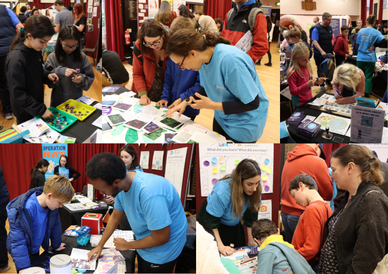

Researchers from the Unit brought activities about Nucleic Acid Therapies to the Big Biology Day at Hills Road Sixth Form College on 11th October.
Cambridge Biologists have been running the Big Biology Day at Hills Road Sixth Form since 2012 and its now one of the largest events of its kind in the UK! This event combines hands on science activities with careers advice and gives sixth form students the chance to share why they love biology. This is the second time that the MRC Toxicology Unit has taken part as we brought our Human Bookshelf activity last year.
This year we launched a new activity called Operation NAT. NATs are an exciting new type of therapy because they can help us treat currently undruggable diseases. Unlike many traditional medicines that target proteins in the cell, NATs target the instructions for the proteins - the DNA and RNA. This means that NATs can be customized for each disease simply by changing the NAT sequence. This is especially useful for rare diseases that only affect a few patients, but together make up about 8% of the population.
However, more research is needed to figure out how to get the therapies where they are needed in the body and avoid side effects. That's what the MRC Toxicology Unit is working to understand, partnering with companies including AstraZeneca to translate academic research into treatments that benefit patients.
At Big Biology Day, our Operation NAT activity took visitors through the journey that scientists and NATs take to treat a disease. This included a passport that guides participants through the activity with fun facts along the way. We gave out over 200 of these at Big Biology Day!
The activities were:
- Mission Map - A giant sensory cell made of fabric that shows the journey the NAT has to take to get to its target. Participants have to correctly identify different parts of the cell - matching with what students learn in GCSE.
- Design your Character - NATs are designable, with different modifications that help it reach the target and avoid being discovered by the immune system. Participants make a lego character, with each part contributing to the NATs ability to get to the disease causing toxic RNA.
- Escape the Endosome - Only around 1% of NATs given to a patient make it to their target. One reason is that when they enter the cell they get stuck in the endosome, the border control centre of the cell. Similar to researchers trying to find ways to help the NAT escape the endosome, participants solve puzzles, finding objects in a hidden picture of our lab and completing a biology wordsearch.
- Destroy the Instructions - Once the NAT has reached the nucleus, it has to find and remove the disease causing toxic RNA. If it binds the wrong target this can remove something important for the cell to work properly and lead to side effects. Participants search in our lucky dip of RNA molecules to find the toxic one. Once they have found it, they can use our mini shredder to destroy it.
Each activity had a matching stamp for completing it, participants who completed all activities could win one of our science comic books. You can download these to read and print at home any time. So far, we have four comic books that tell stories about work we do at the Unit and why it is important with another one in the works.
Researchers also shared their career journeys so far with secondary, sixth form and undergraduate students. They explained that lots of degrees provide a good foundation for careers in toxicology including Biochemistry, Pharmacology, Chemistry, Pharmacy, Medicine, Veterinary Medicine, Environmental Sciences. More information about toxicology careers and training can be found on the British Toxicology Society (BTS) website.
Huge thank you to our volunteers on the day who shared their knowledge, experience and enthusiasm with all of the visitors. Thanks to Vero, Gili, Hashim, Maria, Madeleine, Nobu, Melika, Gwen, Odara and Sophie. Thanks also go to everyone at the MRC Toxicology Unit who helped put this activity together, in particular Anjelika, Emma, Gavin, Eve, Marguerite, Vanessa, Sophie and Melika.
If you would like us to bring Operation NAT to your school, community group or other organisation please get in touch via communications@mrc-tox.cam.ac.uk and we can discuss how we might work together.